Storage system
Pallet racking
Pallet racking laid out around your stock, your forklifts and your building.
Northpoint Fitouts designs, supplies and installs pallet racking for warehouses, factories and distribution centres across the UK.
- More pallet positions
- Better stock access
- Maximum use of your warehouse space
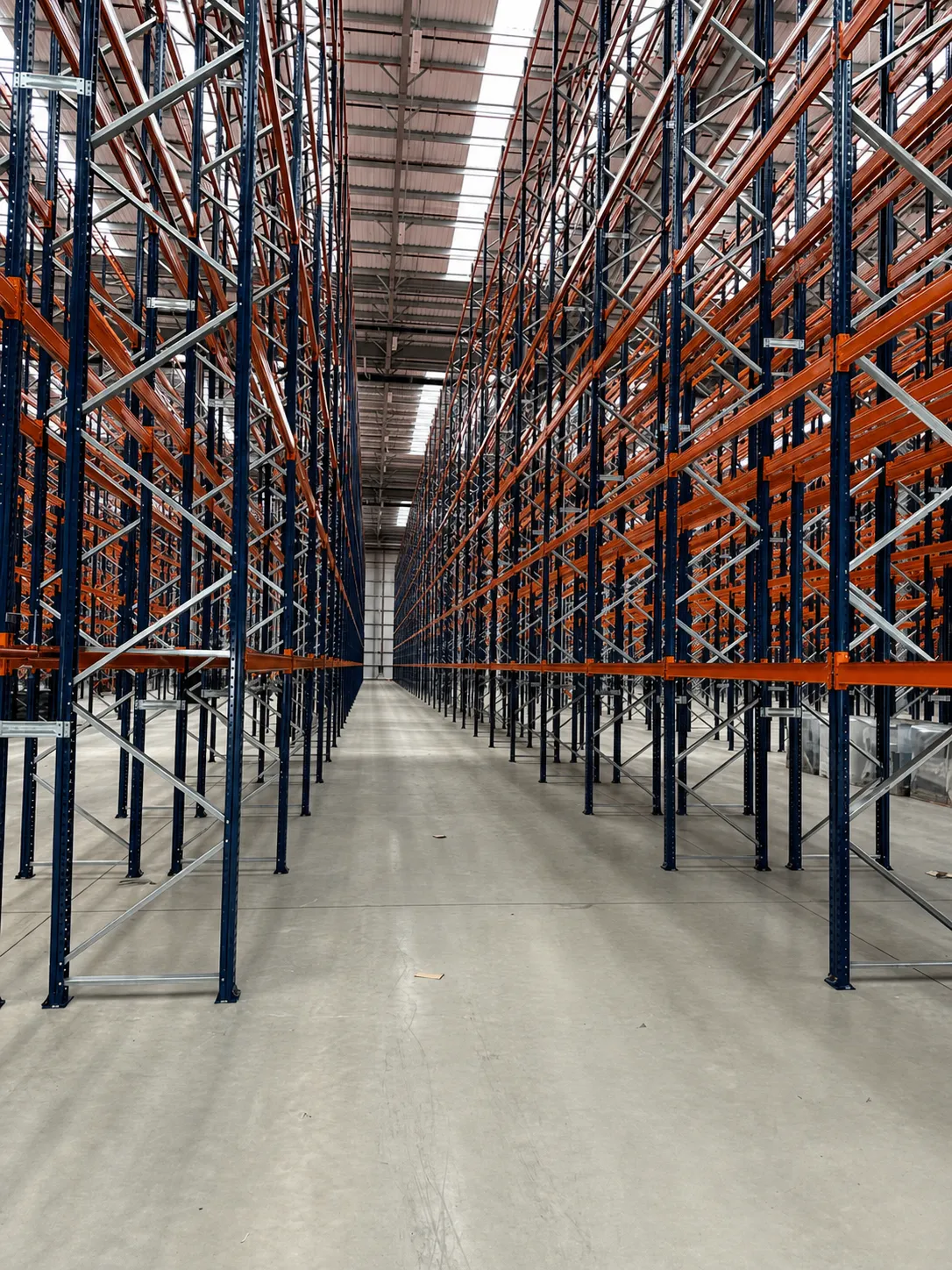
Pallet racking is a steel framework that holds palletised stock in bays, several levels high, so a forklift can put a pallet away and take it back out. Pallet racking systems run from adjustable racking, every position on an aisle, to high-density lanes that give up that access for more pallets.
A standard UK pallet is 1,200 by 1,000mm, a Euro pallet 1,200 by 800mm; both sit across the beams on 900mm or 1,100mm frames. Overhang and odd sizes change the frame depth and the bay count along a wall.
Adjustable pallet racking
Adjustable pallet racking, or APR, is the default and the cheapest way to hold a wide product range. Every position is on an aisle, beam levels move as stock changes, and single parts can be replaced. Roughly half your floor becomes aisle. More on adjustable pallet racking.
High-density pallet storage
Each one buys pallet positions by giving up access.
- Drive-in racking takes the forklift into the lane, pallets on rails: the most a floor can hold, last in first out, and lanes that take damage. For few products held deep: cold stores, drinks.
- Push-back racking runs carts on an incline, two to six deep, loaded from the aisle, quicker to work than drive-in.
- Pallet live racking has sloped lanes, loaded at one end and picked at the other, oldest pallet first, for use-by dates.
- Double deep racking stores two pallets front to back on a longer-reach truck: cheap space, every second pallet blocked.
- Narrow aisle is ordinary racking with tighter aisles worked by guided trucks: more positions, specialist trucks, a very flat floor.
- Cantilever has no front uprights, for timber, pipe, sheet and anything that won’t sit on a pallet.
What you get back
A layout drawing, the pallet count, a parts list and a priced proposal. If the numbers do not justify the work, we’ll say so.
Racking safety
Racking is work equipment: keeping it safe is the operator’s legal duty, not the supplier’s. Every run gets a notice stating the weight it may carry; without one, nobody knows what is safe to lift.
The systems
How deep you store decides the system
Deepen the lanes and watch what the depth buys.
Fig. 02 : One floor at every lane depth
Pallet positions
216
On an aisle face
72
A face is a pallet a truck reaches without moving another first. Everything behind it is cheaper floor and slower stock.
Adjustable (APR)1 deep
Every pallet on an aisle.
Push-back2 to 6 deep
Carts roll the next pallet forward, so trucks stay in the aisle.
Drive-in7 deep and past
Trucks drive into the lanes: the most a floor can hold.
Which system
Which system is right for you?
Not always the one that holds the most pallets. Rank them by what matters.
Medium density, very high selectivity. For a large SKU range.
Density 40 of 100, selectivity 96, affordability 100.
High density, medium selectivity. Several pallets per SKU, loaded from the aisle.
Density 75 of 100, selectivity 62, affordability 48.
Very high density, low selectivity. Bulk quantities of few products.
Density 96 of 100, selectivity 25, affordability 65.
Configurations
Five configurations, one baseline.
Adjustable is the baseline. The other four trade its access for density or reach.
Process
Pallet racking installation, survey to handover
Northpoint Fitouts runs the whole project, not just the delivery.
Drive the project through
- 01
Site survey
We measure the space, the stock, the forklifts and the floor.
- 02
Storage design
A layout drawn around the building and the pallet count.
- 03
Quotation
A written proposal prices the layout and the installation.
- 04
Installation
Installed in phases where the site keeps trading.
- 05
Handover
The runs are inspected and load notices fitted.
Your brief
What we need from you
Five answers start a layout, from 10 more pallet positions to several thousand. Tick what you know and the sheet fills in.
Fig. 03 : The sheet your answers fill in
Next step
Send the five answers. We'll send back a layout.
A free site survey settles what you cannot measure from a desk.
Get a quoteBook a site surveyAgainst its siblings
Five configurations on three axes.
Density, selectivity and affordability decide most warehouse racking choices. The scores are judgements, not measurements.
AdjustableDensity 40 of 100, selectivity 96, affordability 100.
Drive-inDensity 96 of 100, selectivity 25, affordability 65.
Push-backDensity 75 of 100, selectivity 62, affordability 48.
Pallet liveDensity 85 of 100, selectivity 40, affordability 30.
Double deepDensity 60 of 100, selectivity 55, affordability 82.
Questions
Pallet racking, common questions
How much does pallet racking cost?
Pallet racking cost follows the number of positions, the height, the pallet weights and the system. Larger schemes cost less per position. A firm figure needs a layout of your building.
How many pallets can I fit in my warehouse?
Pallet capacity depends on the building dimensions, the clear height, your pallet sizes, the aisles your forklifts need and the racking type. A layout gives the exact count.
What is the most common type of pallet racking?
Adjustable pallet racking, or APR, is the most common. Every position is reached from an aisle, beam levels move as stock changes, and it suits most pallet sizes and trucks.
What is the difference between standard and drive-in pallet racking?
Standard adjustable racking reaches every pallet from an aisle. Drive-in racking replaces the aisles with lanes the forklift enters: more pallets, but only the front is reachable, last in first out.
What is the highest-density pallet storage system?
Drive-in racking, pallet live and other deep-lane systems hold the most, replacing aisles with lanes several pallets deep. Density trades against selectivity: the more a system holds, the fewer pallets are reachable.
How high can pallet racking be installed?
Pallet racking usually goes as high as the building allows, and 12 metres is routine. The limits are clear height, sprinklers, lights and heaters, forklift lift height, and floor flatness above about 8 metres.
Does pallet racking have to be bolted to the floor?
Yes. Pallet racking is designed on the assumption that it's bolted down, and doesn't perform as intended otherwise. The slab must also take the load at each foot.
Do I need a site survey?
Yes, for anything beyond a small addition. Floor condition, slab strength, columns, doors, sprinklers and fire exits decide what goes where, so a survey records them first. Photographs and measurements usually do for a few extra bays.
Can I reuse racking I already have?
Often yes, and usually the biggest saving available. Racking that is identifiable, undamaged and has known weight ratings can be reconfigured and extended. Never mix manufacturers in a run: published ratings apply only to matching components.
Storage that fits
Develop a storage system around your operation
From ten extra positions to a scheme that fills the building, Northpoint Fitouts designs, supplies and installs the racking.